

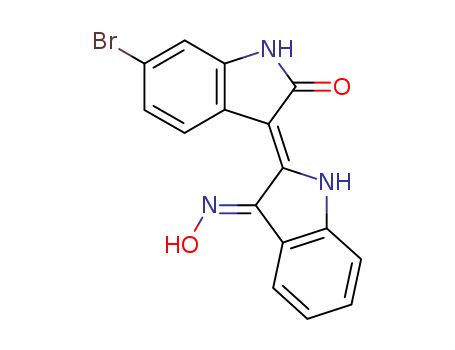
- Product Name6-Bromoindirubin-3'-oxime
- cas667463-62-9
- purity99%

Others
High Quality Chinese Manufacturer supply 667463-62-9 6-Bromoindirubin-3'-oxime
- Molecular Formula:C16H10BrN3O2
- Molecular Weight:356.178
- Vapor Pressure:4.04E-13mmHg at 25°C
- Melting Point:300°C(lit.)
- Refractive Index:1.801
- Boiling Point:554.3°C at 760 mmHg
- PKA:9.56±0.20(Predicted)
- Flash Point:289°C
- PSA:73.72000
- Density:1.8g/cm3
- LogP:3.69230
6-Bromoindirubin-3'-oxime(Cas 667463-62-9) Usage
|
Biological Activity |
Potent and selective, ATP-competitive glycogen synthase kinase-3 (GSK-3) inhibitor (IC 50 values are 5, 83, 300, 320 and > 10 000 nM at GSK-3, CDK5/p25, CDK2/cyclin A, CDK1/cyclin B and other common kinases respectively). Maintains self-renewal and pluripotency in embryonic stem cells via activation of the Wnt signaling pathway in vitro . |
|
Biochem/physiol Actions |
Cell permeable: yes |
|
Enzyme inhibitor |
These protein kinase inhibitors (FWBIO = 356.19 g/mol; CAS 667463-62-9; Solubility: 70 mg/mL DMSO, <1mg/mL H2O), also known as BIO, 6BIO, and systematically as 6-bromo-3-[(3E)-1,3-dihydro-3-(hydroxyimino)-2Hindol- 2-ylidene]-1,3-dihydro-(3Z)-2H-indol-2-one, targets glycogen synthase kinase-3 (or GSK-3), with an IC50 value of 5 nM for α and β forms. BIO also shows greater than 16x selectivity over CDK5 and is also a weaker pan-JAK inhibitor, with IC50 values of 30 nM, 1.5 μM, 8.0 μM, and 0.5 μM for TYK2, JAK1, JAK2 and JAK3. (See the structural related inhibitor 1-Azakenpaullone) BIO, but not 1-methyl-BIO, closely mimicked Wnt signaling in Xenopus embryos. BIO-induced apoptosis of human melanoma cells is associated with reduced phosphorylation of JAKs and STAT3 in both dose- and time-dependent manners. Consistent with inhibition of STAT3 signaling, expression of the anti-apoptotic protein Mcl- 1 was down-regulated. Maintaining Embryonic Stem Cells Pluripotency: Human and mouse embryonic stem cells (ESCs) self-renew indefinitely while maintaining the ability to generate all three germ-layer derivatives. Importantly, Wnt pathway activation by BIO is sufficient to maintain the undifferentiated phenotype in both types of ESCs and sustains expression of the pluripotent state-specific transcription factors Oct-3/4, Rex-1 and Nanog. Such results suggest that BIO and related GSK-3-specific inhibitors may off practical advantages in regenerative medicine. Bio can also participate in controlling the proliferative capability of the highly differentiated cardiomyocytes. Activation of Wnt/β-catenin and inhibition of Notch signaling pathways, as mediated by simultaneous co-application of BIO and the γ-secretase inhibitor N-[(3,5-difluorophenyl)acetyl]-L-alanyl-2- phenylglycine-1,1-dimethylethyl ester (or DAPT), efficiently induces intestinal differentiation of ESCs cultured on feeder cells. These findings that Wnt and Notch signaling function to pattern the anterior-posterior axis of the DE and control intestinal differentiation. 6-Bromoindirubin-3'- acetoxime: This cell-permeable BIO analogue (FWBIO-acetoxime = 398.21 g/mol; CAS 667463-85-6) is active against herpes simplex virus-1 (HSV-1) infection in human oral epithelial cells, the latter representing a natural target cell type. BIO-acetoxime reduces viral yields and the expression of different classes of viral proteins. BIO-acetoxime may suppress viral gene expression and protect oral epithelial cells from HSV-1 infection. Tyrian Purple: BIO’s indirubin nucleus is related to the famous Tyrian purple dye that the Phoenicians isolated from the gastropod mollusk Hexaplex trunculus and gained favor in antiquity, because it did not fade, actually becoming more brilliant upon weathering and exposure to sunlight. The inhibitory properties of BIO suggest that 6-bromoindirubin provides a new scaffold for the development of selective and potent pharmacological inhibitors of GSK- 3. |
|
in vivo |
study showed bio activated maternal wnt signaling pathway in xenopus embryos. it caused a hyper dorso-anteriorization at the expense of trunk and tail in a dose-response manner. it also activated the dorsal genes (siamois and chordin) ectopically. [1] |
|
General Description |
A cell-permeable, highly potent, selective, reversible, and ATP-competitive inhibitor of GSK-3α/β (IC50 = 5 nM). Specificity was confirmed using various Cdk′s (IC50 = 83 nM for Cdk5/p25, 300 nM for Cdk2/cyclin A, 320 nM for Cdk1/cyclin B, and 10 μM for Cdk4/cyclin D1), MAP kinases, PKA, PKC isoforms, PKG, CK, and IRTK (IC50 ≥ 10 μM). Inhibition of GSK by BIO has been shown to result in the activation of the Wnt signaling pathway and sustained pluripotency of human and murine embryonic stem cells (ESCs). |
InChI:InChI=1/C16H10BrN3O2/c17-8-5-6-9-12(7-8)19-16(21)13(9)15-14(20-22)10-3-1-2-4-11(10)18-15/h1-7,18,22H,(H,19,21)/b15-13-,20-14+
667463-62-9 Relevant articles
Biodistribution of Fracture-Targeted GSK3β Inhibitor-Loaded Micelles for Improved Fracture Healing
Low, Stewart A.,Galliford, Chris V.,Yang, Jiyuan,Low, Philip S.,Kope?ek, Jind?ich
, p. 3145 - 3153 (2015)
Bone fractures constitute a major cause ...
Syntheses of indirubins by aldol condensation of isatins with indoxyl anion generated in situ by lipase-catalyzed deacetylation of indoxyl acetate
Hanaya, Kengo,Higashibayashi, Shuhei,Sugai, Takeshi
, p. 129 - 136 (2020/01/28)
The syntheses of indirubin (76% yield), ...
Novel synthesis of 4-or 6-substituted indirubin derivatives
Zhang, Aiying,Yu, Mingfeng,Lan, Tian,Liu, Zenglu,Mao, Zhenmin
experimental part, p. 3125 - 3134 (2010/12/24)
A simple and convenient route for synthe...
INDIRUBIN-TYPE COMPOUNDS, COMPOSITIONS, AND METHODS FOR THEIR USE
-
Page/Page column 27; Figure 2A, (2008/06/13)
Compounds and compositions including 6-b...
667463-62-9 Process route
-
-
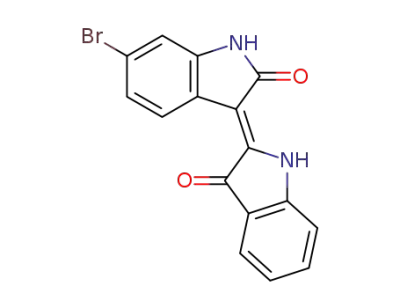
667463-60-7
6-Bromoindirubin

-
-
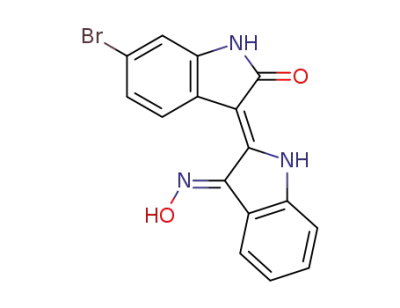
667463-62-9
(2'Z,3'E)-6-bromoindirubin-3'-oxime
Conditions
| Conditions | Yield |
|---|---|
|
With
pyridine; hydroxylamine hydrochloride;
at 120 ℃;
for 3h;
|
73% |
|
With
pyridine; hydroxylamine hydrochloride;
at 120 ℃;
for 1.5h;
|
|
|
With
hydroxylamine hydrochloride;
In
pyridine;
at 120 ℃;
for 1.5h;
Heating / reflux;
|
|
|
With
pyridine; hydroxylamine hydrochloride;
at 115 - 120 ℃;
for 2.5h;
Sealed tube;
Inert atmosphere;
|
|
|
With
pyridine; hydroxylamine hydrochloride;
at 120 ℃;
for 3h;
|
2.17 g |
-
-
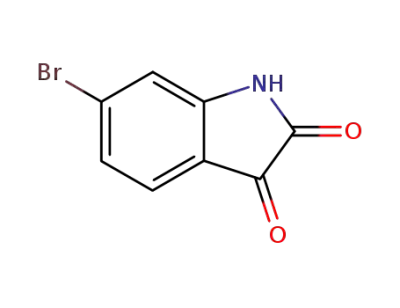
6326-79-0
6-bromoisatin
-
-
667463-62-9
(2'Z,3'E)-6-bromoindirubin-3'-oxime
Conditions
| Conditions | Yield |
|---|---|
|
Multi-step reaction with 2 steps
1: 90 percent / Na2CO3 / methanol / 3 h
2: pyridine; H2NOH*HCl / 1.5 h / 120 °C
With
pyridine; hydroxylamine hydrochloride; sodium carbonate;
In
methanol;
|
|
|
Multi-step reaction with 2 steps
1: sodium carbonate / methanol / 5 h / 25 °C / Inert atmosphere; Darkness
2: hydroxylamine hydrochloride; pyridine / 2.5 h / 115 - 120 °C / Sealed tube; Inert atmosphere
With
pyridine; hydroxylamine hydrochloride; sodium carbonate;
In
methanol;
|
667463-62-9 Upstream products
-
667463-60-7
6-Bromoindirubin
-
6326-79-0
6-bromoisatin
-
591-19-5
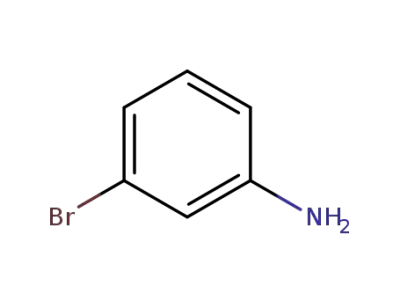
m-Bromoaniline
-
65971-74-6
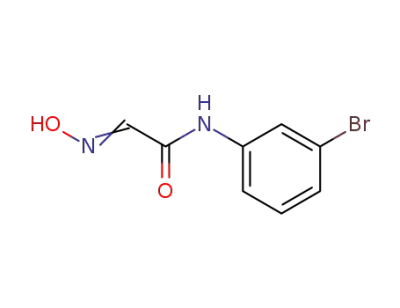
N-(3-bromophenyl)-2-(hydroxyimino)ethanamide
667463-62-9 Downstream products
-
1067884-44-9
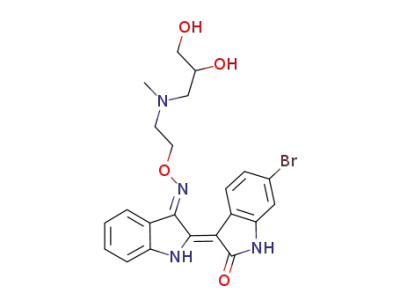
(2'Z-3'E)-6-bromoindirubin-3'-(O-{2-[N-methyl,N-(2,3-dihydroxypropyl)amino]ethyl}oxime)
-
1067884-41-6
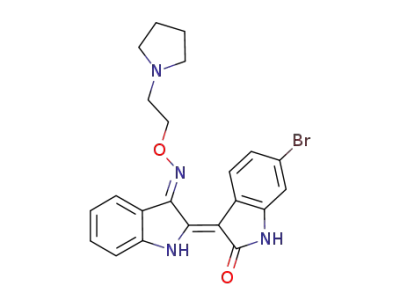
(2'Z-3'E)-6-bromoindirubin-3'-[O-(2-pyrrolidin-1-ylethyl)oxime]
-
1067884-45-0
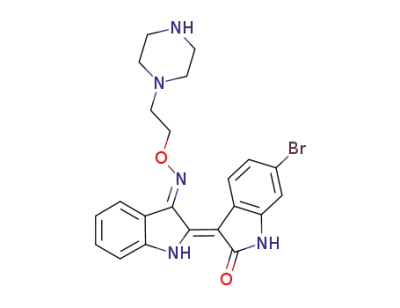
(2'Z-3'E)-6-bromoindirubin-3'-[O-(2-piperazin-1-ylethyl)oxime]
-
1067884-46-1
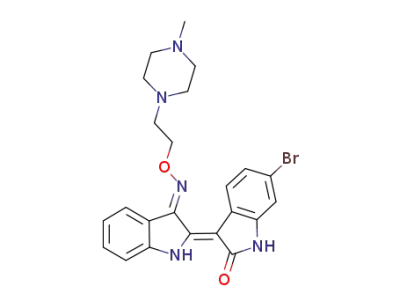
(2'Z-3'E)-6-bromoindirubin-3'-{O-[2-(4-methyl-piperazin-1-yl)ethyl]oxime}

The order has been successfully placed. Our staff will contact you within 24 hours.